 en
 FR
 IT
 ES



About 40 km southeast of Stockholm as the crow flies (approximately 2.5 hours by boat), in the southern part of the Swedish capital’s vast archipelago, lies Utö, an island that is at once wild, welcoming and remarkably rich in history. Its name literally means “the outer island” in Swedish, a name that suits it particularly well: here, the Baltic Sea is ever-present, pine forests alternate with ice-smoothed rocks and small harbours, while the horizon seems to open out towards the open sea.
The Stockholm Archipelago comprises around 30,000 islands, islets, and skerries and stretches for nearly 80 kilometres eastward from the capital. Utö is one of its southernmost islands and is one of the destinations where visitors can experience the distinctive landscapes of the skärgård, the local name for this unique island world.
An Island Shaped by Exceptional Geology
Utö is not only interesting for its landscapes; it is also an exceptional open book for geologists. Its bedrock preserves traces of events dating back approximately 1.9 billion years, to a time when a volcanic mountain range was developing beneath an ancient sea. Sediments, volcanic ash and materials produced by this activity gradually accumulated before being profoundly transformed by heat, pressure and tectonic movements.
This geological history is particularly visible on Utö because many of the rocks have preserved their original structures. The island is home to metamorphosed volcanic rocks, limestone, schist and iron-rich formations. The iron ore veins are associated with ancient hydrothermal processes that concentrated metals within the sediments and volcanic rocks.
But Utö has another spectacular geological feature: its pegmatites, rocks formed from granitic magmas and characterised by exceptionally large crystals. They have yielded a remarkable diversity of minerals, some of which are extremely rare.
This is where a remarkable scientific anecdote comes in. In 1817, Johan August Arfwedson, working on a sample from Utö, identified a new chemical element. He named it lithium, from the Greek lithos, meaning “stone”. Utö is therefore associated with the discovery of lithium, which has since become a strategically important element, particularly for modern batteries.
Iron Mines Nearly a Thousand Years Old
The island’s mineral wealth has profoundly shaped its history. Iron ore mining is believed to have begun as early as the 12th century, making the Utö mines among the oldest in Sweden. The earliest written records, however, date back to the beginning of the 17th century. Mining continued, with interruptions and periods of varying intensity, for around seven centuries.
At its peak, mining completely transformed island society. During the 19th century, the mines employed a large workforce and Utö’s population reached approximately 700 inhabitants around the middle of the century—a considerable number for an island in the archipelago. In 1850, a church was even built to serve the growing population, along with an entire neighborhood of workers’ housing.

The remains of this period are now among the island’s main attractions. Several former mine pits are still visible, some of them now filled with water. The deepest, Nyköpingsgruvan, reaches approximately 215 metres. The imposing spoil heaps and excavations give the landscape an almost lunar appearance.
Mining finally came to an end in 1879, as it became too costly in the face of new industrial techniques and changes in railway transportation. Utö’s economic landscape then changed dramatically. Mining activities disappeared, and the island gradually turned towards agriculture, maritime services and eventually tourism.

A Relatively Small Population, but a Lively Island
Today, the contrast with the mining era is striking : around 250 people live on Utö year-round, according to the local heritage society. In summer, however, the population swells with the arrival of second-home owners, sailors, and tourists.
This relatively small permanent population does not mean that the island is asleep. Utö has a school, shops, restaurants, cafés, accommodation, and a marina. The island is also considered a year-round destination, although summer is by far the busiest season.
A Turbulent History Between Sea, War, and Tourism
Utö’s geographical position also explains its strategic importance. Located near a major maritime route, the island served as a base for pilots, lighthouse keepers, customs officers, and military personnel. A permanent community developed there during the 18th century around these maritime activities.
More recently, the military presence was for many years an integral part of island life, and fortifications and installations built during the early 20th century have left their mark on the landscape. Although the Swedish Armed Forces eventually withdrew from Utö at the end of 2005, parts of the island are still temporarily used as firing and training grounds by the Stockholm Amphibious Regiment and NATO. Visitors are strongly advised to pay attention to the signs and barriers that clearly indicate military activity.

What to Do on Utö
The best way to discover the island is probably simply to take your time. Rental bicycles are particularly convenient for exploring the roads and paths connecting the different sites. Pine forests, small beaches, rocky viewpoints overlooking the sea, and traditional hamlets create a quintessentially Swedish landscape.
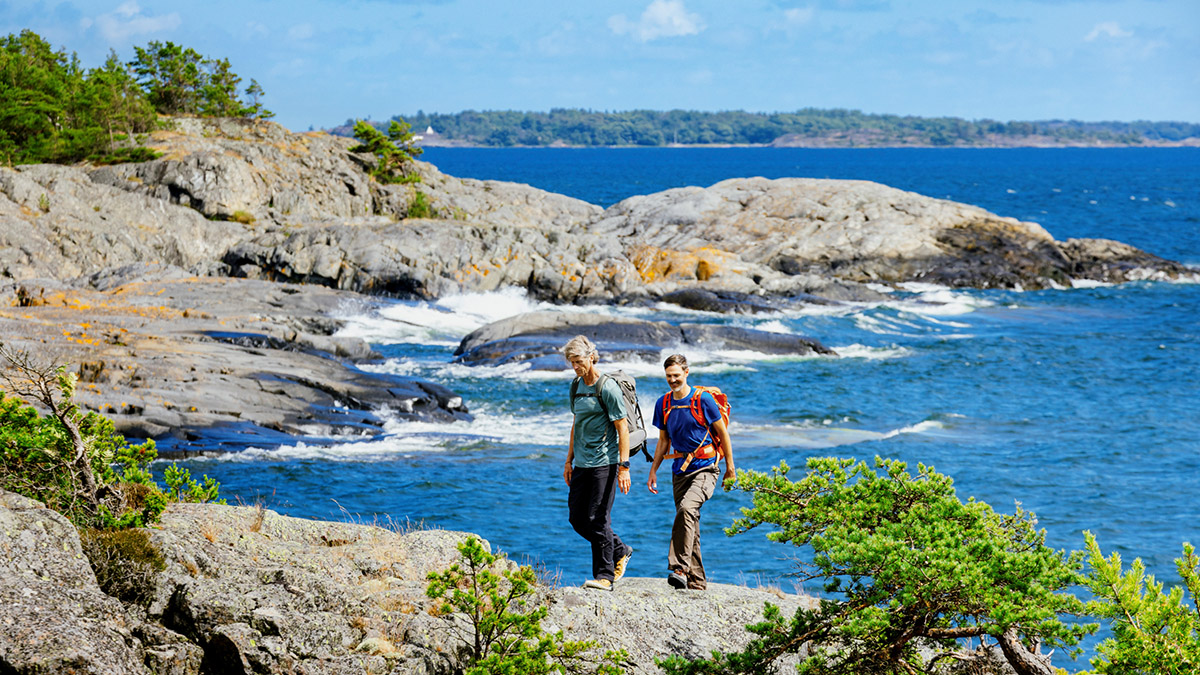
Hiking enthusiasts can also follow the Stockholm Archipelago Trail, a long-distance hiking route crossing several islands in the archipelago. The Utö section is approximately 16.7 kilometres long and offers a succession of coastal landscapes, woodland, and exposed rocky outcrops.
 Image Bank Sweden / Henrik Trygg
The old mines are naturally an essential stop. Visitors can also explore the Utö Mining Museum, dedicated to the history of iron mining and the island’s exceptional mineralogy. The old village buildings, church, and windmill are also part of the island’s cultural heritage.
For those who prefer the sea, Utö has several beaches and swimming spots. Kayaking, cycling, hiking, and sailing are all excellent ways to enjoy its natural environment. In summer, the restaurants and cafés contribute to a much livelier atmosphere, while autumn and winter reveal a quieter, almost melancholic side of the island.
Utö, Between Industrial Heritage and Maritime Paradise
What makes Utö so fascinating is precisely this mixture of opposites. It is a holiday island where people come to swim, cycle, and enjoy a meal overlooking the sea, but it is also a former mining territory where every rock tells a story of almost unimaginable age.
Beneath the pine trees and red-painted houses lies a past nearly two billion years old. The old mines tell the story of Sweden’s industrial heritage. In the harbour, the memory of sailors, pilots, and military personnel still lingers. And along the paths, between the rocks and beaches, one discovers the more peaceful face of an island that has now chosen to live to the rhythm of the sea.

Utö is therefore much more than a day trip from Stockholm: it is a meeting point of geology, history, nature, and island culture, all concentrated within a territory that can be explored by bicycle or on foot in just a few hours. A perfect destination for understanding why the Stockholm Archipelago has fascinated visitors for so long.
Learn more about the whole of Stockholms's archipelago thanks to our article here.
Curious about other famous islands near Stockholm? Look at Vaxholm, Sandhamn and Grinda.
Contact us here for a tailormade private guided excursion to your favorite island !


